Fake Out-of-Home as a driver of social media amplificationWhen FOOH advertising really works, where it backfires, and how it extends a real campaign in the feed.
Fake Out of Home (FOOH): What it is about
Fake Out of Home, often shortened to FOOH, refers to digitally created outdoor advertising that exists only in virtual form and is primarily distributed through social media. Unlike traditional OOH formats such as billboards, FOOH uses CGI (Computer Generated Imagery) to place digital brand elements into real-world settings. These clips often show staged scenes at iconic landmarks, creating strong moments of surprise for viewers.
The choice of those well-known locations is no coincidence, but are deliberate selection because they boost attention and strengthen the overall effect. A 2024 Harris Poll study found that 65 percent of adults are more inclined to engage with a brand when they see it in a well-known place, and 46 percent automatically associate such settings with higher quality. The effect is especially pronounced among Gen Z, millennials and people living in major urban areas.
This strong attention makes FOOH highly shareable. The unusual visuals encourage users to watch, react and circulate them in their social feeds. FOOH therefore taps directly into the principle of social media amplification. Content spreads far beyond its original audience because users actively pass it on.
FOOH campaigns on social platforms
The rise of Fake Out of Home can be seen in numerous well-known examples. One of the most widely discussed cases was Maybelline’s “mascara subway.” The clip begins in an ordinary London Underground station, but the arriving train is equipped with oversized eyelashes and appears to be brushed by a giant mascara wand. Although the scene looked real, it was entirely created with CGI. Similar FOOH concepts include a vision of Big Ben wearing a The North Face jacket on a gloomy day in London.
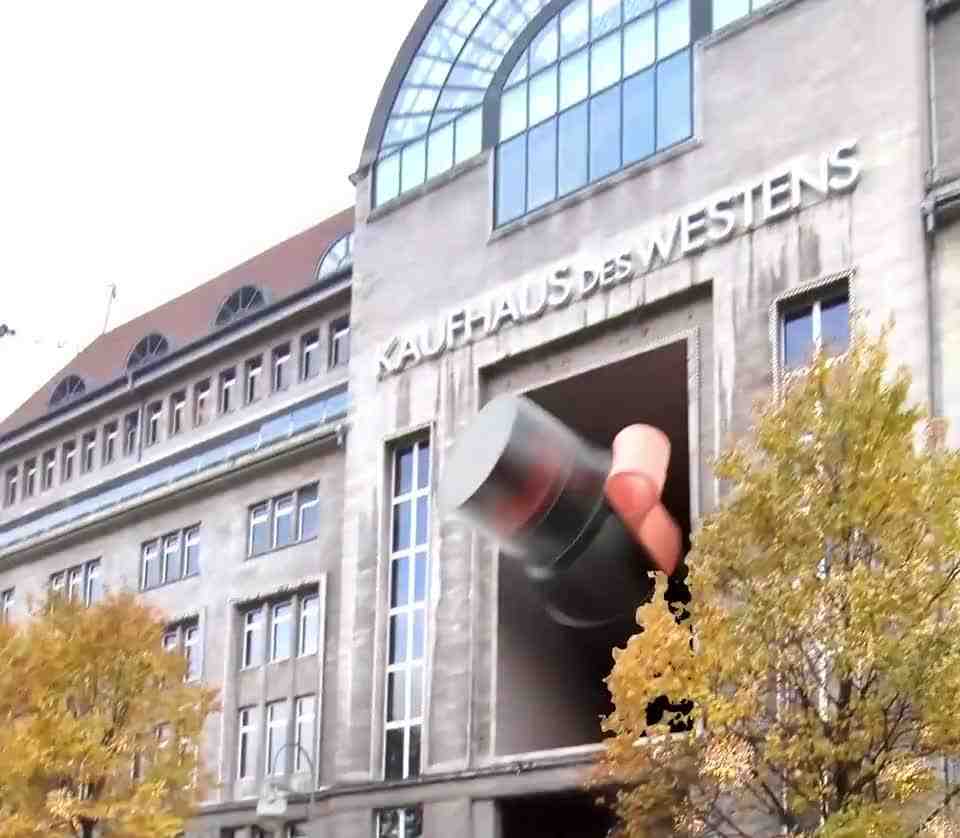
In Germany, Echo Poster brought Air Up into the spotlight at the KaDeWe in Berlin. In a FOOH clip, an enormous Air Up bottle appears to float out of the building. The video was shared frequently on social media, including by well-known entrepreneurs such as Frank Thelen, and achieved reach far beyond Berlin.
FOOH in practice
FOOH is one of the most influential advertising trends of recent years, and beauty brands embraced it early. A selection of publicly documented campaigns where the principles show:
- Maybelline, “Sky High Mascara” (London, 2023). An Underground train with a giant lash is brushed by an oversized mascara as it passes. 76 million views (Beauty Packaging).
- adidas, “Impossible Rondo” (Dubai, 2022). A reactive CGI clip at the Dubai Frame after Argentina’s World Cup win. 160 million organic views (The Drum).
- Jacquemus, “Bags on Wheels” (Paris, 2023). Oversized Le Bambino bags roll through Paris like cars. Around 2 million likes (Dialect).
- L’Oréal Paris, “Matte Resistance” (Paris, 2023). A Citroën 2CV draws a bright red lipstick trail across the cobblestones. 3.5 million views in two days (Famous Campaigns).
- Barbie / Mattel (Dubai, 2023). A giant Barbie in original packaging next to the Burj Khalifa. Over 3 million views (Harper’s Bazaar).
- The North Face / JD Sports (London, 2023). Big Ben in a puffer jacket, later the Eiffel Tower (Creative Bloq).
Strong potential for earned media
Brands can realise ambitious ideas through FOOH at relatively low cost while generating significant attention through social media amplification. Elaborate stunts can be simulated digitally without the logistical expenses of real installations, location fees or permits. Successful clips can reach millions of viewers online. Although CGI campaigns do not generate physical impressions on the street, they create high visibility through online views.
The reach generated this way counts as earned media. The associated KPI, the Earned Media Value (EMV), measures how much unpaid attention a campaign receives through likes, comments and shares that do not require paid promotion.
Even smaller companies can create memorable experiences through FOOH at a fraction of the cost of real-world activations. Fake Out of Home leverages the logic of social platforms and the amplification effect. The result is significant awareness and measurable earned media.
FOOH as an extension of your real campaign: the air up example
The real campaign
Oversized air up inflatables on Alexanderplatz in Berlin and by the Thames in London bring the brand into the cityscape.
Actions on the street
Influencer stunts with a branded bathtub in Berlin, London and Paris, plus reverse graffiti on the pavement, make the campaign tangible.
The FOOH clip
A giant air up bottle floats by CGI in front of KaDeWe in Berlin. Same look, a format built for the feed.
Social reach
The virtual clip carries the campaign into the feed and reaches the audience that never passed the installation. The street makes it real, social makes it big.
Using FOOH responsibly
While FOOH offers many advantages, it also comes with challenges. Viewers often cannot immediately tell that a scene is digitally produced, which can lead to disappointment when people try to visit a supposed installation that never existed in physical form. Clear communication is therefore important. If it is not transparent that the content is CGI, trust issues can arise.
There is also the question of legitimacy, as virtual campaigns use real locations as backgrounds without paying for the media space. Many iconic places also require special permissions for commercial use. For these reasons, brands should apply FOOH strategically, ideally in combination with traditional OOH. This allows them to benefit from the wow effect without damaging credibility.
FOOH: strengths and limits
- Viral reach without media costs for the space
- Creative freedom that is hard to achieve in reality
- A strong amplifier for a real OOH campaign
- Fast to react to cultural moments
- Likes are not real on-site impressions or footfall
- The novelty effect wears off as the format becomes common
- If the fake is sold as real, credibility is lost
- Without a story it stays a technical gimmick
FOOH reach compared
Conclusion
FOOH is a powerful addition to the interaction between OOH and social media. It creates striking imagery that is ideal for viral distribution, but it does not replace real outdoor advertising. Instead, it enhances it. When used transparently and integrated into a broader cross-media strategy, FOOH can become a strong driver of social media amplification and maximize a campaign’s reach and impact.
FOOH vs. classic OOH
| Classic OOH | FOOH | |
|---|---|---|
| Where it exists | physically in the city | only as a video, digital |
| Reach | real impressions on site | reach in the social feed |
| Main costs | space booking, production, build | CGI production, seeding |
| Credibility | tangible, permanently present | depends on transparency and idea |
| Best role | load-bearing campaign base | amplifier and buzz trigger |
Frequently asked questions about Fake Out-of-Home
What does FOOH mean?
FOOH stands for Fake Out-of-Home, virtual outdoor advertising created with CGI that exists only digitally. Instead of a real billboard, a clip places an advertising message into a real scene and is shared on social media.
What is the difference between FOOH and classic OOH?
Classic OOH hangs physically in the city and creates real impressions on site. FOOH exists only as a video and creates reach through social media. FOOH does not replace OOH, it amplifies it as a social amplifier.
What makes a FOOH campaign go viral?
A clear effect, a well-known location as a backdrop and a visual that surprises and invites sharing. According to a Harris Poll (2024), 65 percent of adults are more likely to engage with a brand when they see it in an iconic location.
What affects the cost of a FOOH campaign?
The price depends mainly on CGI production effort, the complexity of the visual, the number of clips and the social distribution afterwards. FOOH saves the space booking of classic OOH; the effort shifts into production and seeding.
Stay loud.
Once a month: new spots, cases and out-of-home know-how. No spam.
Contact
Phone
+49 30 692090213Inspirations
Planning a campaign?
Request a campaign